


Empirio: Learn Business
4.84.00 Reviews
App Specs
- Version
- 1.11.1
- Updated On
- License
- Free
- Downloads
- 10,000+
- Developer
- Deepstash SRL
- Categories
- Education
- Platform
- Android
Screenshots




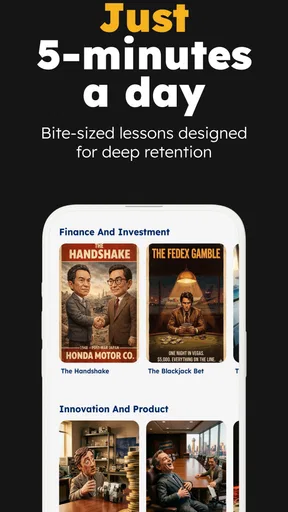
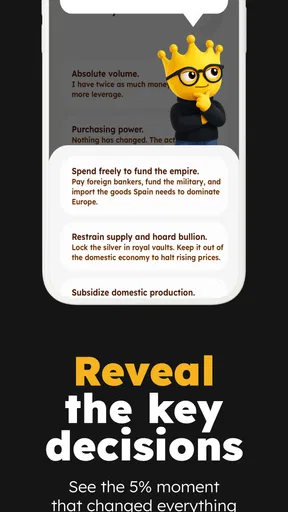


 Analysis by AppCompare
I approached Empirio: Learn Business as a short, decision-focused learning app rather than as a conventional business course. Its central idea is appealing: instead of beginning with definitions and long lessons, it asks you to understand business through the choices that shaped real history. That gives the experience a more active starting point. You are not simply collecting terms; you are trying to think through a situation and see why a particular decision mattered.
That distinction is important if you are deciding whether this Education app belongs in your routine. I found it most interesting when I had a few spare minutes and wanted something more useful than casual scrolling, but did not have the concentration for a full lecture or textbook chapter. The app is free, aimed at everyone, and developed by Deepstash SRL. Its public reception is encouraging, with a 4.8 average from roughly two hundred ratings and more than ten thousand installs, although that is still a relatively young audience compared with established learning platforms.
From a vague business question to a practical learning session
The best way to use Empirio is to begin with a specific question rather than opening it with no intention at all. For example, I might start a session wondering how a company decides between fast growth and controlled expansion, how leadership choices affect employees, or why a business strategy that looks sensible can fail in practice. The historical-decision format works better when I treat each situation as a small problem to solve, not as a stream of facts to consume.
That starting condition also reveals the app’s main strength. Traditional business learning often presents the final answer first: a definition, a framework, or a summary of what a successful company did. Empirio makes the route to the answer more active. I have to consider the pressure surrounding a decision, weigh competing outcomes, and then connect the result with a broader business lesson. Even when the situation is simplified, that mental step is more memorable than highlighting a paragraph.
I would recommend beginning with a short, focused goal. A new learner could use it to build familiarity with business vocabulary and decision-making. Someone already studying management could use it as a way to test whether they can apply an idea outside a classroom example. A founder or team leader might use a session as a prompt before discussing a difficult choice with colleagues. The app is not a replacement for detailed research, but it can help turn an abstract topic into a question that feels immediate.
There is also a useful psychological advantage to this approach. When I make a choice before seeing its consequence, I notice the assumptions behind my own thinking. Did I prioritize short-term cash flow? Did I underestimate how people would react? Did I assume that a strong product would automatically overcome weak execution? Those questions are more valuable than simply remembering a company name or a date. The learning comes from examining the reasoning, not only from discovering whether the decision worked.
How I would move through a session
I treat each decision as a three-part exercise. First, I identify the immediate problem and the pressure around it. Second, I compare the available directions and ask what each one sacrifices. Third, I review the historical outcome and translate it into a principle I could recognize elsewhere. That final translation is the step many bite-sized learning tools leave to the user, so I make it deliberate.
Worth Reading Before You Choose

Baby Panda World Brings Quick Play to Modern Phones, but Its Game Library Feels Busy

ESPN’s Live Game View Makes Following Close Games Easier

QuizzLand Review: A Good Fit for Short Trivia Breaks, Not Every Player

Basketball Stars: Multiplayer Is Fast, but Can It Recover When Matches Go Wrong?

WEBTOON Turns Phone Updates Into a Better Reading Routine

Link to Windows Runs on Shared Habits, Not Social Feeds
For instance, after a scenario about expansion, I would write a brief note such as “growth creates operational risk when the organization cannot support it.” I would then attach a modern example from my own work or studies. This takes only a moment, but it changes the app from passive entertainment into a personal revision tool. The unusual insight here is that the value is not limited to choosing correctly. Choosing incorrectly can be just as useful if I can identify the assumption that led me there.
A second practical technique is to delay looking for the “right” business lesson. I first make a decision using only the information in front of me, then compare my reasoning with the outcome. If I immediately search for the moral, I tend to agree with it too easily. The small amount of uncertainty before the explanation is what makes the historical example useful. It exposes the difference between a decision that sounds wise afterward and one that was genuinely difficult at the time.
I would also avoid treating a single session as a complete lesson. The app’s format is better suited to building a chain of observations. After several scenarios, I would group my notes under themes such as incentives, timing, competition, leadership, or execution. This workflow creates a handoff from the app to my own reflection. Without that handoff, the experience risks becoming a series of interesting choices that I enjoy briefly but cannot apply later.
That is where Empirio feels different from a business podcast. A podcast may offer richer context and a more developed narrative, but it usually asks me to listen continuously and accept the presenter’s structure. Here, I have to participate earlier. The trade-off is depth: the app can make a decision vivid, while a book or lecture is normally better for understanding the surrounding market, financial details, and long-term consequences.
The handoff from the app to real work
The most useful handoff happens when I connect a historical decision with a present task. Imagine that I am preparing for a meeting about a new product. Before the meeting, I could use Empirio to think about a similar tension between speed, quality, and available resources. I would not copy the historical answer. Instead, I would use it to prepare three questions: What constraint are we accepting? Which group carries the risk? What evidence would tell us to change direction?
After the meeting, I could return to those questions and compare them with what actually happened. This makes the app part of a complete workflow: the initial business problem becomes a structured prompt, the decision scenario supplies a comparison, and the real meeting provides an outcome to evaluate. That is a more demanding use than simply completing a session, but it is also where the app can have lasting value.
Students can create a similar handoff. After using a scenario, they can explain their choice to a classmate before reading the outcome, then defend or revise their reasoning afterward. This turns an individual activity into a discussion without requiring a large study group. For teachers, the app could serve as a conversation starter, although I would still want a separate source for definitions, historical context, and assessment material.
For someone changing careers, the handoff may be even more practical. Business concepts can feel distant when they are presented as terminology. A decision-based example gives the learner a situation to describe in an interview: how different priorities create different risks, or why a manager might choose resilience over immediate growth. The app does not provide a ready-made professional answer, and that is a limitation, but it can help a learner form a more thoughtful one.
One friction point is that the quality of the handoff depends heavily on the user. Empirio can create the moment of reflection, but it cannot guarantee that I will record the lesson, discuss it, or apply it. If I am looking for a complete course that tracks mastery and guides me from beginner concepts to advanced practice, a structured learning platform will probably serve me better. This app is stronger as a decision laboratory than as a full curriculum.
What I take away after the decision
The result of a good session is not merely a correct choice. I want to finish with a clearer understanding of trade-offs. Business decisions rarely involve an option that is entirely good and another that is entirely bad. One may protect the present while limiting the future; another may create opportunity while increasing exposure. The historical framing helps make those tensions visible, especially for learners who are accustomed to studying outcomes without reconstructing the uncertainty that came before them.
I also appreciate that the format can improve the way I read business news. After working through decisions, I become more likely to ask what information was available at the time, who benefited from the choice, and which consequence was unintended. That is a more mature reading habit than judging every result as proof that a leader was brilliant or foolish. In this sense, Empirio can be useful beyond the app itself: it gives me a lens for examining business stories.
The app is particularly well suited to people who learn through contrast and consequence. If you remember ideas better when you make a prediction first, the interactive structure should feel natural. If you prefer a quiet explanation followed by organized notes and definitions, the experience may feel incomplete. Neither learning style is wrong, but the difference affects whether the short decision format becomes engaging or frustrating.
Its rating suggests that early users have responded positively, and the install count shows that it has already reached a modest audience. I would still interpret those signals with some caution because a small, newer app can have a concentrated user base. What matters more to me is whether the format matches my purpose. If I want a free way to add thoughtful business prompts to a commute, lunch break, or study interval, the answer is yes. If I need verified financial analysis, professional certification preparation, or a comprehensive management reference, the answer is no.
The current version is 1.11.1, and the app runs on Android 7.0 or later. That makes it accessible to people using older Android devices, which is helpful for an educational tool intended for broad use. Still, compatibility alone does not solve the larger question of continuity. I would want to see whether the available material remains fresh and varied over time, because a decision-based app loses some of its appeal if the same small set of situations becomes familiar too quickly.
Where the learning flow can break
The first break occurs when a user expects historical decisions to behave like objective case-study answers. A business outcome is shaped by timing, competition, people, resources, and information that may not fit neatly into a short interaction. If I treat the app’s conclusion as a universal rule, I can learn the wrong lesson. The better approach is to ask what conditions made the decision sensible and whether those conditions exist in my own situation.
The second break is a lack of detail. A short scenario can introduce a strategic conflict, but it cannot replace a financial model, a market report, or a long account of organizational change. This is why I would pair Empirio with a textbook or reliable articles when studying seriously. The app gives me an entry point and a way to test my instincts; other resources must supply evidence and depth.
A third break appears when I use it without reflection. Tapping through decisions can feel productive even when nothing changes in my understanding. My practical fix is simple: after each session, I write one sentence about the trade-off and one question I still have. If I cannot do that, I probably consumed the activity rather than learned from it. This small habit is one of the most important ways to get more from the app.
There is also a social limitation. Business decisions are often valuable because people disagree about them, while an individual app session can keep the reasoning private. If I am studying with others, I would pause before revealing my choice and ask someone else what they would do. The disagreement becomes part of the lesson. For solo learners, recording a short voice note or explaining the decision aloud can provide some of that missing challenge.
Finally, the app is not the right choice for someone who wants a conventional sequence with explicit milestones. A course platform is better when I need a syllabus, exercises that build in a fixed order, progress reporting, or formal proof of completion. A business news app is better when I want current events. A reference book is better when I need precise terminology. Empirio earns its place between those options by making business history feel like a set of choices rather than a list of outcomes.
My recommendation after using it
I would recommend Empirio: Learn Business to curious learners, students who want a more active supplement, and professionals who enjoy examining the reasoning behind strategic choices. Its free access removes an easy barrier to trying it, and the Everyone age rating makes it suitable for a broad audience. I especially like it for short sessions that lead into another activity: a class discussion, a planning meeting, a journal entry, or a conversation about leadership.
I would not recommend relying on it alone for serious business education. Its strongest contribution is the starting point it gives me: a decision, a tension, and a reason to think. The outcome becomes genuinely useful only after I carry it into my own notes, questions, and work. That handoff is both the app’s opportunity and its responsibility as a learner.
In the end, Empirio: Learn Business works best when I use it as a practical thinking companion rather than a finished course. It helps me practice looking at business choices before judging their results, and that is a valuable habit. If you want quick prompts that make business history feel active, it is worth trying. If you need exhaustive explanations, current data, or a guided qualification path, choose a deeper alternative and use this app only as a complement.
Pros
- Short lessons make business topics easy to study in spare moments.
- Covers practical subjects such as marketing
- finance
- and entrepreneurship.
- Useful for beginners seeking a structured introduction to business concepts.
- Progress tracking helps maintain a consistent learning routine.
- Clean interface makes course navigation simple on mobile devices.
Cons
- Advanced learners may find some explanations too basic.
- Some lessons provide limited depth compared with full business courses.
- A stable internet connection may be needed for certain content.
- The app may not replace accredited training or professional qualifications.
- Course availability and features can vary depending on the subscription plan.
FAQs for Empirio: Learn Business
What is Empirio: Learn Business?
Empirio: Learn Business is an educational app designed to introduce users to essential business concepts through interactive lessons and practical scenarios. It may cover topics such as entrepreneurship, management, marketing, finance, decision-making, and business strategy. The app is aimed at learners who want a convenient way to study business fundamentals on a mobile device, whether they are beginners, students, or aspiring entrepreneurs.
Who is Empirio: Learn Business suitable for?
The app is generally suitable for beginners and anyone interested in understanding how businesses operate. Students, aspiring entrepreneurs, professionals changing careers, and users who want to refresh their business knowledge may find the bite-sized learning format useful. However, it should be viewed as an introductory learning tool rather than a replacement for accredited courses, professional qualifications, or advice from experienced business and financial specialists.
Does Empirio: Learn Business require an internet connection?
Internet requirements can depend on the specific feature being used and the version installed on your Android or iOS device. Lessons, account synchronization, progress tracking, advertisements, or updated content may require an active connection, while some previously loaded material could potentially remain available offline. Before relying on the app for travel or study without data access, check its current store description and test the lessons on your device.
Is Empirio: Learn Business free to download and use?
Empirio: Learn Business may be available as a free download, but some features, lessons, advanced content, or an ad-free experience could be restricted behind in-app purchases or a subscription. Pricing and available plans can change by country, platform, and developer update. Review the Google Play Store or Apple App Store listing carefully, including trial terms and recurring billing details, before confirming any purchase.
Can Empirio: Learn Business replace a business course or professional advice?
No. Empirio: Learn Business can be useful for learning terminology, reviewing basic principles, and building an initial understanding of business topics, but it should not be treated as a complete academic program. Real-world business decisions often require current market research, detailed financial analysis, legal guidance, and professional experience. Use the app as a supplementary learning resource and verify important information through reliable, up-to-date sources.


